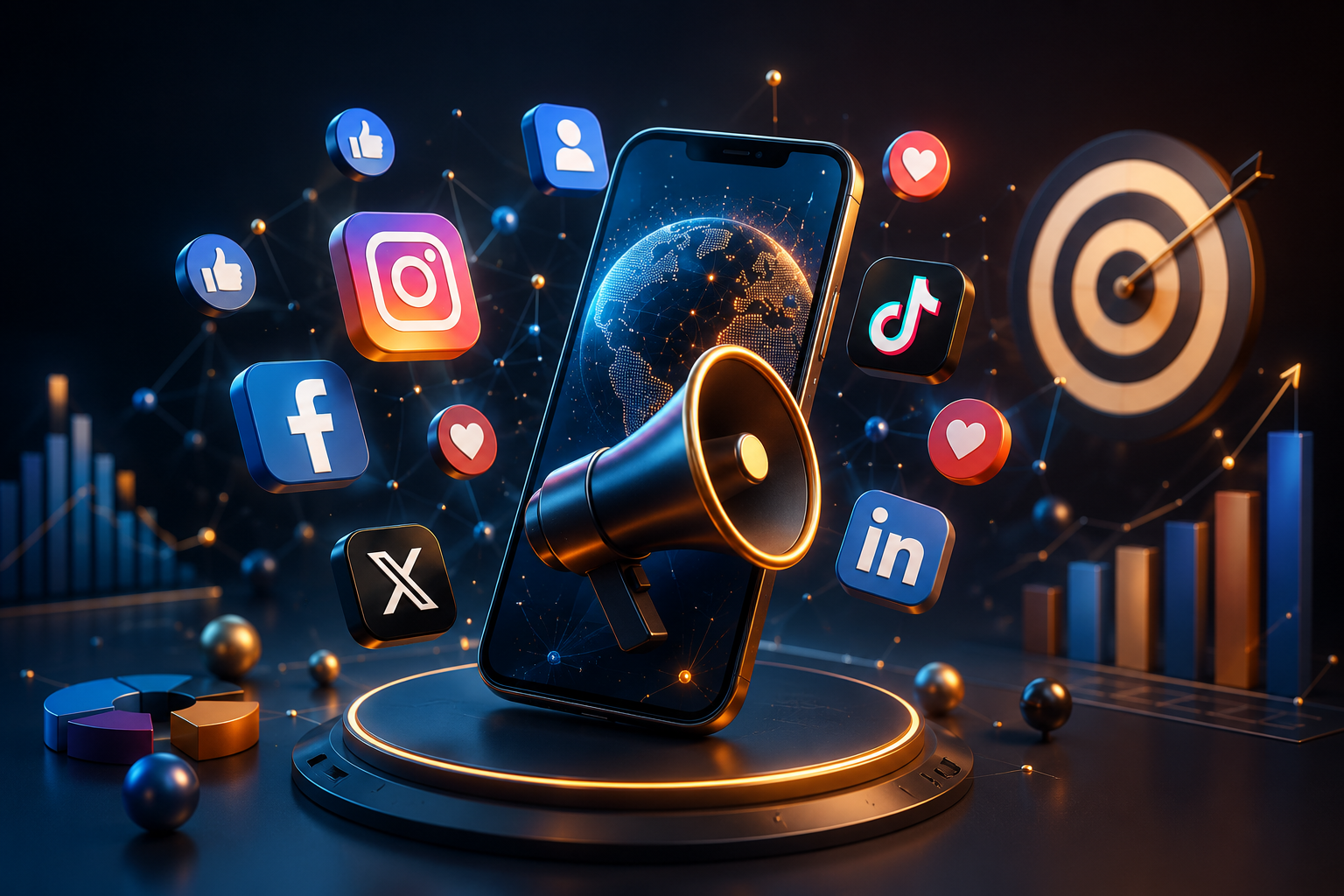
Social media marketing (SMM) is the practice of using platforms like Instagram, LinkedIn, Facebook, YouTube, and TikTok to build brand awareness, connect with audiences, and drive sales through content, engagement, and paid ads. Done right, it turns followers into customers. Done randomly, it’s just noise.
This guide breaks down exactly how social media marketing works in 2026 — the strategy, the platforms, the tools, and the mistakes that keep most beginners stuck.
Table of Contents
- What Is Social Media Marketing?
- Why It Matters in 2026
- The 7-Step Social Media Marketing Strategy
- Choosing the Right Platforms
- Organic vs Paid Social Media
- Tools Every Marketer Should Know
- Common Mistakes Beginners Make
- How to Start a Career in Social Media Marketing
- FAQs
1. What Is Social Media Marketing?
Social media marketing means creating and distributing content on social platforms to achieve a business goal — awareness, leads, sales, or community trust. It combines three things:
- Content — posts, videos, reels, stories
- Engagement — replies, comments, DMs, community management
- Advertising — paid campaigns to extend reach beyond organic followers
It is not the same as posting randomly. A brand posting five times a day with no goal is not doing marketing — it’s doing activity.
2. Why It Matters in 2026
The average person now spends well over two hours a day on social platforms. That’s not just scroll time — it’s research time. A large share of Gen Z and millennial buyers say a social post or recommendation directly influenced a purchase decision.
Three shifts define 2026 specifically:
- Search is moving to social. People search “best X near me” on Instagram and TikTok before Google.
- AI-generated answers cite social content. AI Overviews and chat assistants pull from Reddit, LinkedIn, and YouTube more than they did two years ago — so a strong social presence now feeds AEO (answer engine optimization), not just SEO.
- Short-form video is the default entry point, not a bonus channel.
3. The 7-Step Social Media Marketing Strategy
A strategy is a documented plan, not a posting schedule. Here’s the framework that holds up across industries:
Step 1 — Set SMART goals. Not “grow engagement.” Instead: “Get 500 qualified leads from Instagram and LinkedIn by Q4.” Specific, measurable, tied to a number.
Step 2 — Know your audience. Build a simple persona: age range, platform habits, biggest pain point, what content format they actually consume (video vs text vs carousel).
Step 3 — Audit what’s already working. Look at your last 20 posts. Which 3 performed best? Do more of that pattern before inventing new ones.
Step 4 — Pick 1–2 platforms, not five. Brands that do two platforms well outperform brands that do five platforms thinly. Choose based on where your audience already is, not where you personally like posting.
Step 5 — Build 3–5 content pillars. Recurring themes (e.g., tips, behind-the-scenes, case studies, trends, FAQs) stop you from reinventing content every week and make your brand feel consistent.
Step 6 — Set a realistic posting cadence. Cadence varies wildly by platform — roughly 1 post/day on LinkedIn, several times a week on Instagram, multiple pins a day on Pinterest, 1 video/week on YouTube. Consistency beats frequency.
Step 7 — Measure monthly, adjust quarterly. Track reach, engagement rate, click-through, and conversions — not vanity likes. Drop what isn’t working every quarter.
4. Choosing the Right Platforms
| Platform | Best for | Content type |
| Brand awareness, visual products | Reels, carousels, stories | |
| B2B, personal brand, hiring | Text posts, articles, video | |
| YouTube | Long-term SEO + AEO authority | Long-form + Shorts |
| Local business, older audience | Community groups, ads | |
| TikTok [if in your country] | Discovery, younger audience | Short-form video |
| Visual search, e-commerce | Pins, infographics |
Rule of thumb: pick the platform where your buyer spends time, not where content is easiest to make.
5. Organic vs Paid Social Media
Organic builds trust slowly. Paid buys speed. In 2026, relying on organic alone is risky — algorithm reach for organic posts has been shrinking for years across most platforms. A practical split for most small businesses: 70% organic content for trust and community, 30% budget on paid boosts for your best-performing organic posts (don’t build ads from scratch — amplify what already proved itself).
6. Tools Every Marketer Should Know
- Scheduling: Buffer, Hootsuite, Later
- Design: Canva, Adobe Express
- Analytics: native platform insights + Google Analytics for traffic attribution
- Social listening: Brand24, Mention
- AI content assist: for drafting captions/ideas — always edit for brand voice, never post raw AI output
7. Common Mistakes Beginners Make
- Posting without a goal attached
- Copying competitors’ content instead of their strategy
- Being on every platform instead of doing 1–2 well
- Ignoring comments and DMs (engagement is half the job)
- Never checking analytics, so the same mistakes repeat monthly
8. How to Start a Career in Social Media Marketing
If you’re learning this as a skill rather than running it for your own brand, the practical path looks like:
- Learn the fundamentals (strategy, platforms, ad basics) through a structured course
- Run a real account — your own or a small local business — as a portfolio piece
- Get comfortable with one ads platform (Meta Ads Manager is the most common starting point)
- Learn basic analytics reporting — clients and employers care about numbers, not follower count
- Apply for internships or freelance micro-projects to build proof of results
A structured, mentor-led course shortens this path considerably compared to self-teaching from scattered YouTube videos, mainly because it forces you to work on real campaigns with feedback instead of guessing.
9. FAQs
What is social media marketing in simple words? It’s using platforms like Instagram, Facebook, and LinkedIn to promote a business through content, interaction, and ads — instead of traditional advertising alone.
Is social media marketing a good career in 2026? Yes — demand is growing as more businesses shift ad budgets from traditional media to social. Entry-level roles favor candidates with a real portfolio over a certificate alone.
How much does social media marketing cost for a small business? Organic-only can cost close to zero besides time. Paid campaigns typically start productively from a modest monthly ad budget, scaled up once a campaign proves it converts.
Which platform is best for social media marketing? There’s no single best platform — it depends on where your target audience spends time. B2B leans LinkedIn; visual products lean Instagram/Pinterest; younger audiences lean TikTok.
How long does it take to see results from social media marketing? Organic growth typically shows meaningful traction in 3–6 months of consistent posting. Paid campaigns can show results within weeks but need budget to sustain them.