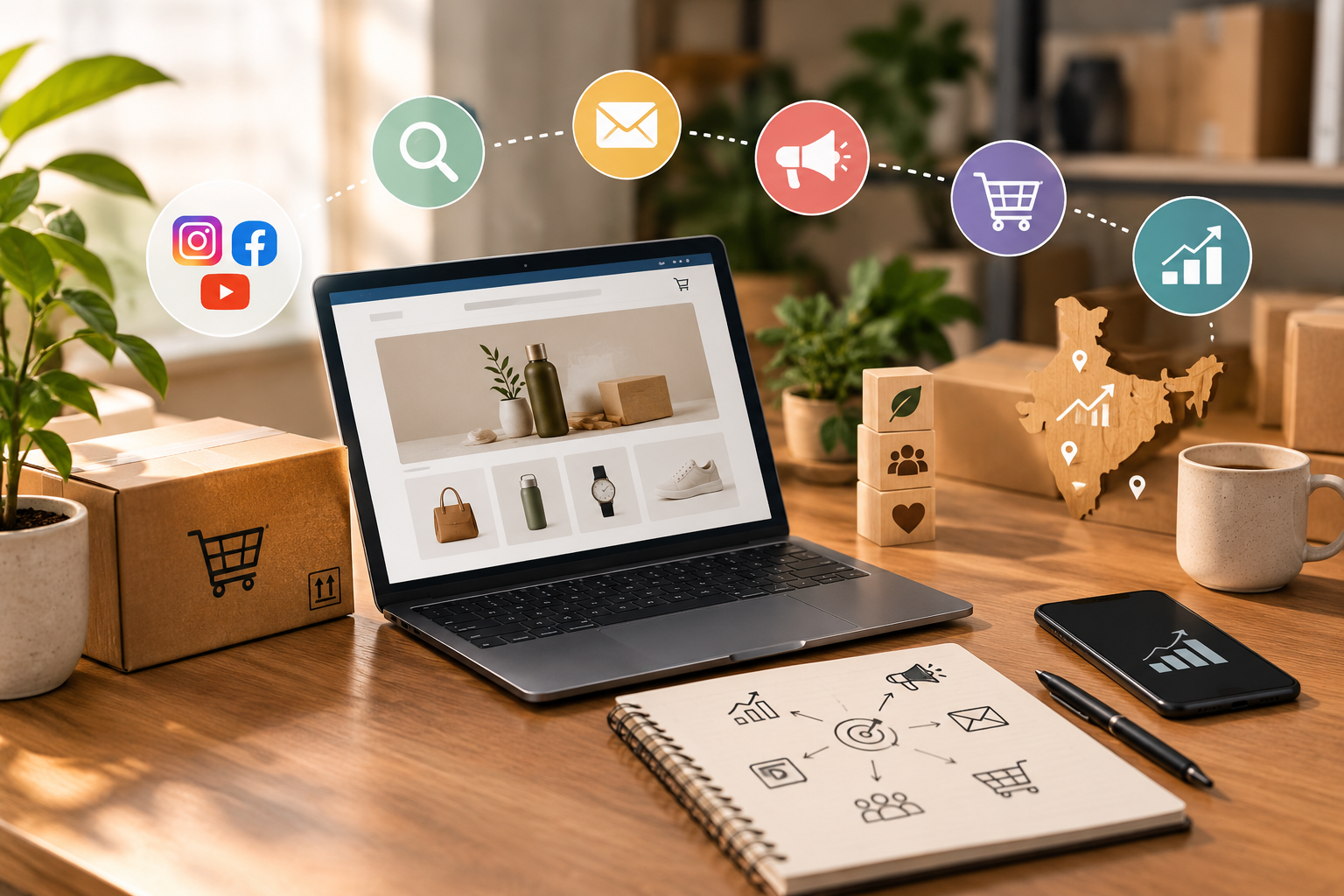
India’s D2C market has become highly competitive. Launching a good product is no longer enough. Your brand needs to reach the right audience, build trust quickly, convert visitors into customers, and give existing customers a reason to return.
A strong digital marketing strategy for D2C brands India brings these activities together instead of treating Instagram, Google Ads, SEO and email marketing as separate channels. In this guide, you’ll learn how to build a practical strategy that works across the customer journey.
If you’re looking to build skills for digital marketing strategy for D2C professionally, a digital marketing course in Jaipur can help you develop practical knowledge of SEO, paid advertising, social media and analytics.
Start With a Clear D2C Marketing Foundation
Before spending money on advertising, define exactly who you are selling to and why they should choose your brand.
Identify Your Target Customer
Create a simple customer profile based on:
- Age and location
- Interests and lifestyle
- Purchasing behaviour
- Problems your product solves
- Price sensitivity
- Preferred platforms
For example, a skincare brand targeting young urban consumers may focus heavily on Instagram, influencer content and educational SEO. A home-products brand may rely more on Google Search, marketplaces, YouTube and remarketing.
Define Your Brand Positioning
Your positioning should answer one simple question:
Why should someone buy from you instead of another D2C brand?
Your answer could be based on ingredients, design, price, convenience, sustainability, performance or a particular customer experience.
Build a Strong Website and SEO Strategy
Your website is more than an online catalogue. It is where your marketing efforts ultimately need to convert attention into revenue.
A good D2C website should have:
- Clear product benefits
- High-quality product images
- Simple navigation
- Mobile-friendly design
- Prominent calls to action
- Customer reviews
- FAQs
- Secure checkout
- Fast-loading pages
Use SEO to Capture Purchase Intent
SEO can help your brand attract people who are already searching for solutions.
Instead of targeting only broad keywords, create content around different stages of buying intent.
For example:
Informational:
“how to choose a face serum”
Commercial:
“best face serum for oily skin”
Transactional:
“buy vitamin C serum online”
Product pages, category pages, blogs and FAQs can work together to capture these searches.
For D2C brands, SEO is particularly useful because it can create a long-term acquisition channel that isn’t entirely dependent on continuously increasing advertising budgets.
Use Paid Advertising for Faster Customer Acquisition
Paid advertising can generate traffic much faster than organic channels, but your campaigns need a clear structure.
Meta Ads
Instagram and Facebook are particularly useful for visually driven D2C categories such as:
- Fashion
- Beauty
- Skincare
- Food
- Home décor
- Accessories
- Lifestyle products
Test different creative formats rather than relying on one advertisement. Product demonstrations, customer problems, before-and-after concepts, UGC-style videos and founder-led content can all be tested.
Google Ads
Google Ads can capture people who are actively looking for a product or solution.
Search campaigns are particularly valuable for high-intent keywords, while Shopping and remarketing campaigns can help bring potential customers back to your website.
The key is to measure profitability, not simply clicks or impressions.
Make Content Part of Your D2C Strategy
Content should help customers understand your product and reduce hesitation.
A practical content mix could include:
Educational content:
Teach customers about problems, solutions and product usage.
Product content:
Demonstrate features, benefits and use cases.
Social proof:
Show reviews, customer experiences and user-generated content.
Brand content:
Tell customers what your brand stands for and what makes it different.
Short-form video can be particularly useful for discovery, while longer educational content can support SEO and consideration.
Focus on Conversion and Customer Retention
Getting visitors to your website is only half the job.
If hundreds of people visit your product page but very few purchase, increasing advertising spend may simply increase wasted budget.
Review your:
- Product-page conversion rate
- Add-to-cart rate
- Checkout abandonment
- Average order value
- Customer acquisition cost
- Repeat purchase rate
Build Retention Into the Strategy
A successful digital marketing strategy for D2C shouldn’t depend entirely on finding a new customer every time it wants to make a sale.
Use email, WhatsApp and other permitted communication channels to maintain relationships with customers.
You can create campaigns for:
- Welcome messages
- Product education
- Abandoned carts
- Post-purchase guidance
- Replenishment reminders
- New product launches
- Loyalty offers
Retention becomes particularly important for products that customers purchase repeatedly.
Track the Metrics That Actually Matter
One of the biggest mistakes in D2C marketing is focusing too heavily on vanity metrics.
A post receiving thousands of views doesn’t automatically mean your business is growing.
Instead, connect marketing activity to business outcomes.
Important metrics include:
CAC: How much it costs to acquire a customer.
ROAS: Revenue generated relative to advertising spend.
Conversion rate: Percentage of visitors who purchase.
AOV: Average amount spent per order.
Repeat purchase rate: How effectively you retain customers.
Create an Integrated Digital Marketing Strategy for D2C
The strongest digital marketing strategy for D2C brands India isn’t about choosing one platform.
Think of your channels as a connected system:
Social media → Website → Conversion → Email/WhatsApp → Repeat purchase → Referral
For example, Instagram may introduce someone to your brand. Google Search may capture their product research. Your website converts them. Email or WhatsApp helps with post-purchase communication, and a strong customer experience encourages another purchase.
This integrated approach also gives you more data to understand where customers are dropping out of the buying journey.
If you’re interested in developing these skills for a career, explore a digital marketing institute in Jaipur that combines concepts with practical campaign and analytics training.
Conclusion: Build for Sustainable D2C Growth
A successful digital marketing strategy for D2C brands India starts with the customer, not the advertising platform.
Define your audience, establish strong positioning, build a conversion-focused website, invest in SEO, test paid campaigns, create useful content and continuously measure acquisition and retention.
Don’t try to dominate every platform immediately. Start with the channels where your customers actually spend time, measure results and scale what works.
For D2C brands, the goal isn’t simply to generate more traffic. It’s to build a marketing system that turns attention into customers and customers into repeat buyers.
Frequently Asked Questions
What is the best digital marketing strategy for D2C brands in India?
There isn’t one universal strategy. Most D2C brands benefit from combining SEO, social media, paid advertising, content marketing and retention campaigns based on their target audience, product category and buying cycle.
Which platform is best for D2C marketing in India?
The right platform depends on your customers and product. Instagram and Meta platforms can work well for visually driven products, while Google can capture users with strong purchase intent. Testing and measuring results is more reliable than choosing a platform based only on popularity.
How much should a D2C brand spend on digital marketing?
There is no fixed amount suitable for every brand. Your budget should depend on product margins, customer acquisition costs, available cash flow and growth objectives. Start with controlled testing before significantly increasing advertising expenditure.
Is SEO important for D2C brands?
Yes. SEO can help D2C brands attract customers who are actively researching products and solutions. Optimised product pages, category pages, FAQs and useful content can create a sustainable source of organic traffic over time.
How can D2C brands increase repeat purchases?
Brands can improve retention through good post-purchase experiences, personalised communication, replenishment reminders, loyalty programmes, useful product education and relevant offers. The exact approach depends on how frequently customers naturally need the product.
Should D2C brands focus on paid ads or organic marketing?
Most growing brands can benefit from both. Paid advertising can provide faster testing and customer acquisition, while SEO and organic content can build longer-term visibility. Using both channels reduces dependence on a single acquisition source.
Get Full Syllabus on WhatsApp or Book a Free Counselling Call with Tech Career today.