AI is moving beyond simply answering questions. Modern AI systems can interpret information, make decisions, use tools, and sometimes complete tasks with limited human intervention.
That shift has made terms such as AI agents and agentic AI increasingly common. But they are not exactly the same thing. If you are wondering what is difference between ai agent and agentic AI, the easiest way to understand it is to look at the difference between a system that performs a task and a broader approach where AI can plan, reason, and act toward a goal.
If you are building skills for a career in digital marketing, you can also explore a digital marketing course in Jaipur to understand how AI-powered tools are changing content, advertising, analytics, and automation. Refer to text below to deeply understand the difference between ai agent and agentic AI.
What Is an AI Agent?
An AI agent is a software system designed to perform a specific task or series of tasks based on a goal, instructions, and available information.
Instead of only generating an answer, an AI agent can take action. Depending on its design, it may collect information, interact with software, make a decision, or complete a defined workflow.
For example, an AI customer-support agent could:
- Read a customer’s question
- Identify the issue
- Search a knowledge base
- Generate a suitable response
- Create a support ticket when necessary
The important point is that an AI agent is generally the individual system or actor performing these actions.
What Is Agentic AI?
Agentic AI is a broader concept describing AI systems that demonstrate a degree of autonomy in pursuing goals.
Rather than following one fixed instruction from beginning to end, an agentic AI system may determine what steps are needed, plan a sequence of actions, evaluate results, and adjust its approach.
For example, imagine asking an AI system to research competitors and prepare a marketing report. A more agentic system might:
- Break the objective into smaller tasks.
- Gather information from multiple sources.
- Analyse the findings.
- Identify missing information.
- Perform additional research.
- Organise the results into a report.
This is why understanding what is difference between ai agent and agentic AI requires looking beyond terminology. An AI agent is a component or system, while agentic AI describes a broader capability or behaviour.
What Is Difference Between AI Agent and Agentic AI?
The simplest distinction is agent vs. agency.
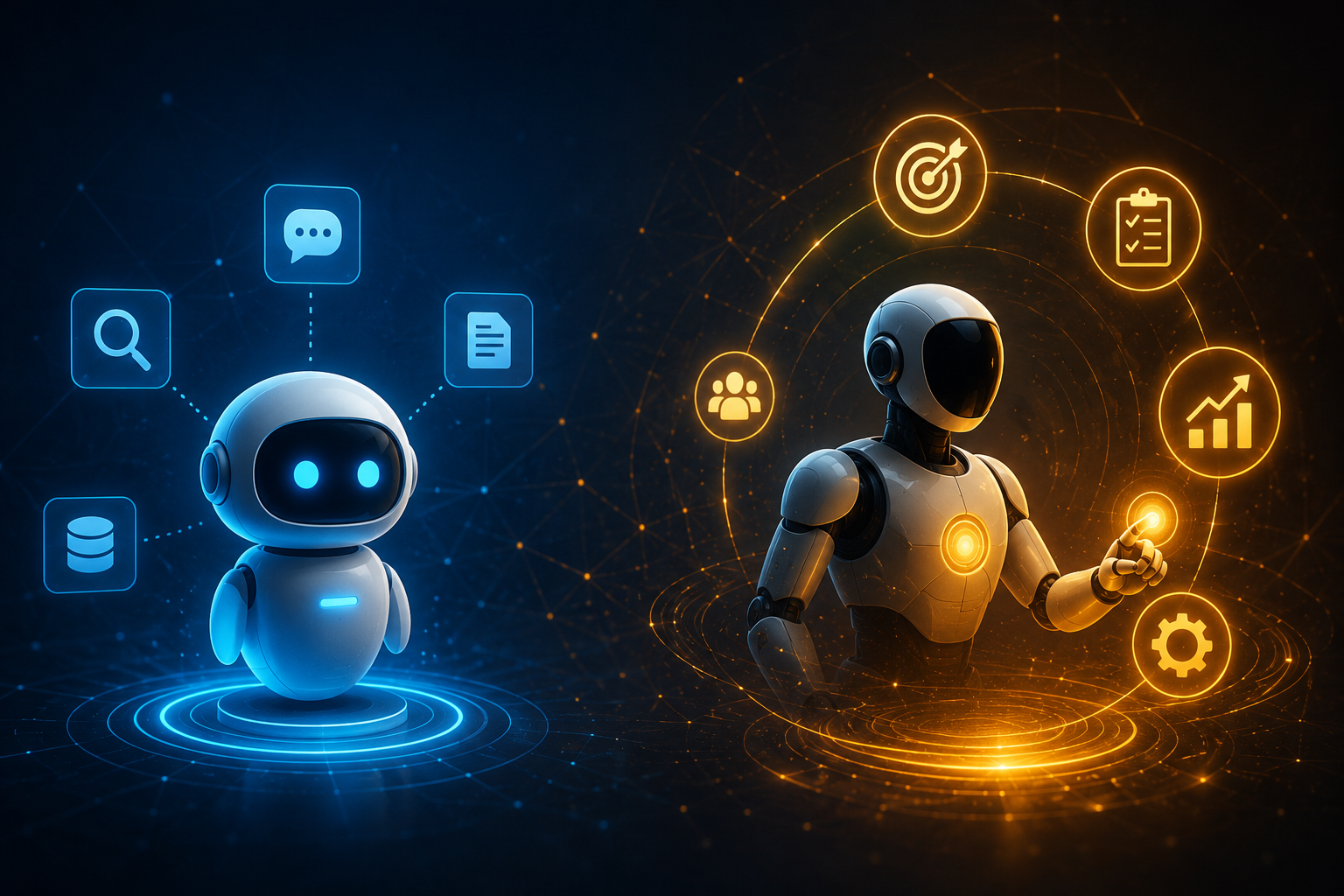
An AI agent is a specific AI-powered system that can perform actions toward a defined objective. Agentic AI refers to the broader ability of an AI system to operate with greater autonomy, planning, reasoning, tool use, and adaptation.
Think of it this way:
AI Agent: “Perform this task.”
Agentic AI: “Achieve this goal and determine the steps required.”
However, the boundary is not always strict. An AI agent can have agentic characteristics, and multiple agents can work together inside an agentic AI system.
Quick comparison
AI Agent:
- Usually designed around a defined task or workflow
- Can use tools and external systems
- May follow predetermined decision logic
- Can operate with limited autonomy
Agentic AI:
- Focuses on goal-oriented behaviour
- Can involve planning and multi-step reasoning
- May adapt actions based on results
- Can coordinate multiple agents or tools
So, when someone asks what is difference between ai agent and agentic AI, the answer is not that they are completely separate technologies. They exist on a spectrum of increasingly autonomous AI systems.
How Do AI Agents and Agentic AI Work?
Both approaches generally rely on several common building blocks.
Goal and instructions
The system needs an objective, such as answering a customer query, analysing data, or creating a campaign.
Reasoning and planning
The AI determines what information or actions may be required to move toward the goal.
Tools and external systems
An agent may connect with databases, APIs, websites, business software, search systems, or other applications.
Memory and context
Some systems maintain information from earlier steps so they can make better decisions during a workflow.
Feedback and evaluation
More advanced systems can evaluate an outcome and decide whether another action is necessary.
AI Agent vs Agentic AI: Real-World Examples
Consider an e-commerce business.
A basic AI agent could answer questions such as “Where is my order?” by checking an order database and returning the delivery status.
An agentic AI workflow could handle a broader objective: “Reduce unresolved customer complaints.” It might analyse support conversations, identify recurring problems, categorise complaints, recommend solutions, and trigger follow-up workflows.
Marketing provides another example. An AI agent could generate social media captions from a supplied brief. An agentic AI system could potentially analyse campaign performance, identify weak content, suggest new ideas, create variations, and help organise the next campaign.
This distinction is useful for digital marketers, developers, analysts, and business owners because the technology is increasingly being integrated into everyday workflows.
Why Does This Difference Matter for Tech Careers?
Understanding the difference between ai agent and agentic AI is useful even if you are not planning to become an AI engineer.
Digital marketers may use AI for research, content workflows, campaign analysis, personalisation, and automation. Developers can build applications that connect AI models with tools and business systems. Data professionals can support AI systems with structured information and analytics.
If you are interested in building a broader digital skill set, a digital marketing institute in Jaipur can help you develop practical knowledge around SEO, content, analytics, paid advertising, and AI-assisted marketing workflows.
The key career skill is not simply knowing AI terminology. It is understanding how to identify tasks that can be automated, where human judgement is still needed, and how AI systems can fit into a real business process.
Key Takeaways
The difference between ai agent and agentic AI becomes easier to remember when you separate the terms.
An AI agent is a specific system capable of taking actions toward a defined task or goal.
Agentic AI refers to a broader approach in which AI systems can demonstrate greater autonomy through planning, reasoning, tool use, adaptation, and goal-oriented action.
Neither term should automatically be treated as a completely separate technology. An AI agent can be part of an agentic AI architecture, and the level of autonomy can vary significantly between systems.
If you are preparing for a career where AI will influence marketing, development, analytics, or e-commerce, understanding these concepts is a useful starting point.
Frequently Asked Questions
1. What is difference between ai agent and agentic AI?
An AI agent is a specific system designed to perform tasks and take actions toward a goal. Agentic AI is the broader concept of AI systems operating with greater autonomy, planning, reasoning, and adaptation.
2. Is an AI agent the same as agentic AI?
Not exactly. An AI agent can be one component of an agentic AI system. Agentic AI describes the behaviour and architecture that allow AI to pursue goals with a higher degree of autonomy.
3. Can AI agents work without human intervention?
Some AI agents can operate automatically after receiving instructions, while others require human approval for important decisions. The amount of human involvement depends on the system’s design, permissions, and risk level.
4. What are examples of agentic AI?
Examples can include systems that research a topic across multiple steps, coordinate software tools, analyse results, revise their approach, or manage a larger workflow based on a defined business objective.
5. Is agentic AI important for digital marketing?
Yes. Agentic workflows can potentially support research, content planning, campaign analysis, reporting, customer interactions, and repetitive marketing processes. Human review remains important for strategy, accuracy, brand voice, and sensitive decisions.
6. Do I need coding skills to understand AI agents?
No. Basic concepts can be understood without programming. However, coding, APIs, automation, data handling, and AI development skills become increasingly useful if you want to build or customise AI-agent systems.
Start Building Future-Ready Digital Skills
AI agents and agentic AI are changing how many professional tasks are performed. The practical advantage comes from understanding where these systems can save time, improve workflows, and support better decisions without removing the need for human expertise.
If you want to build practical skills in SEO, content marketing, analytics, advertising, and AI-assisted digital workflows, explore the digital marketing course in Jaipur at Tech Career.
Get Full Syllabus on WhatsApp or Book a Free Counselling Call with Tech Career today.