
If you’ve been scrolling job portals lately, you’ve probably noticed something: half the openings mention SEO, performance marketing, content strategy, or social media management — even in industries that have nothing to do with tech. That’s not a coincidence. Every business, from a Jaipur boutique to a national logistics chain, now needs someone who can get it found online.
So the question isn’t really “does digital marketing have a future.” It’s “where exactly does it fit into your future.” This guide walks through the digital marketing career scope in 2026 — the roles that are actually hiring, the skills recruiters expect, how AI is reshaping the job (not eliminating it), and what a realistic path into the field looks like if you’re starting today.
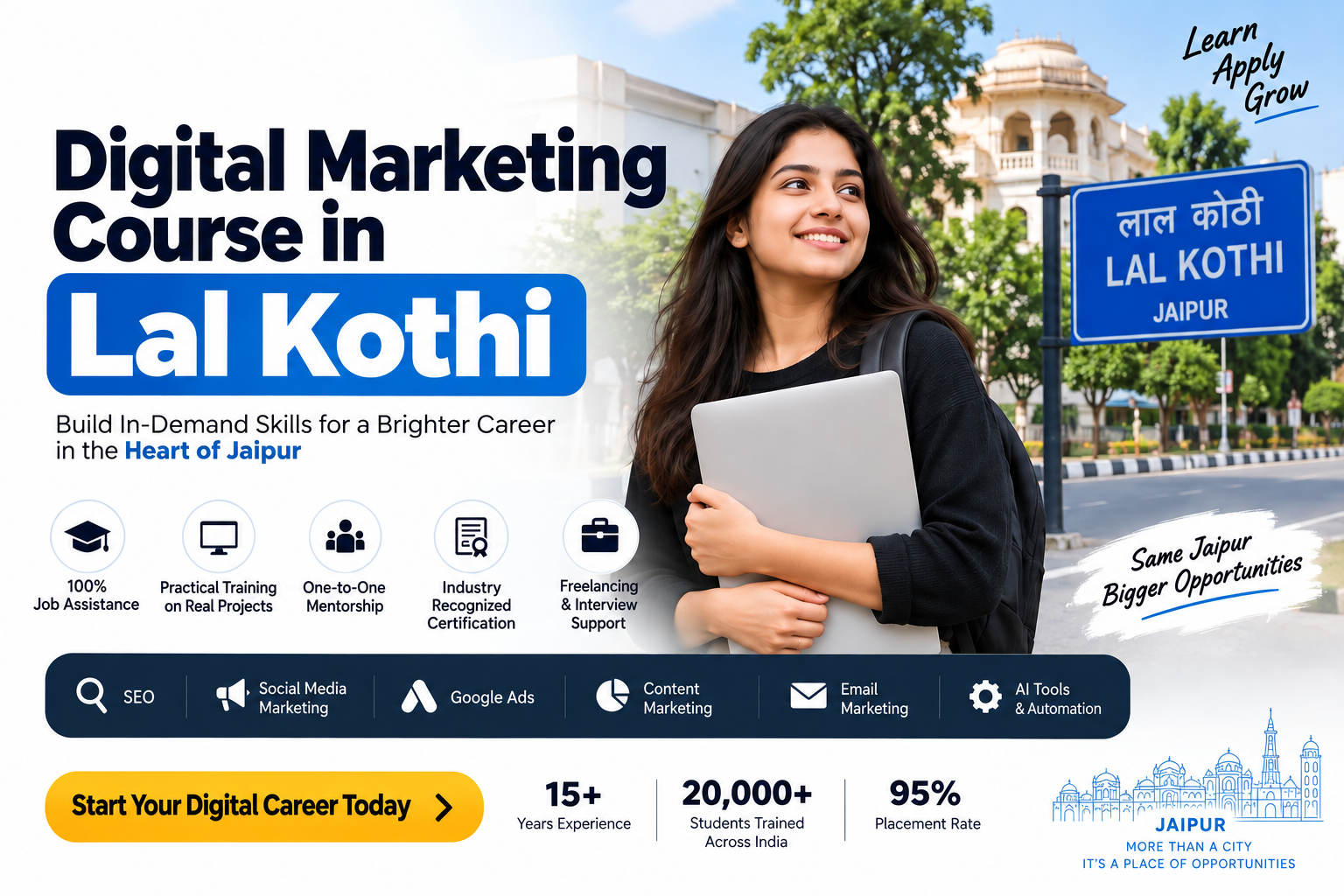
If you’re weighing whether to invest time in this field, this is written to help you decide with real information, not hype. And if you already know you want structured training, a solid digital marketing course in Jaipur can shorten the distance between “interested” and “employable” considerably.
Why Digital Marketing Career Scope in 2026 Looks Different From 2020
The field hasn’t just grown — it’s changed shape. A few shifts are driving this:
Ad budgets have moved online for good. Traditional print and TV spends keep shrinking every year as brands chase measurable returns. That shift isn’t reversing; it’s a structural change in how businesses allocate marketing money.
Small and mid-sized businesses have entered the game. It used to be that only large brands ran serious digital campaigns. Now a local clinic, a D2C skincare brand, or a Tier-2 city retailer all need a digital presence to survive against bigger competitors. This has widened the hiring pool far beyond metro-only agency jobs.
AI tools have raised the bar, not lowered demand. Tools that write ad copy or generate reports have automated the repetitive parts of the job. What’s left — and what’s now more valued — is strategy, data interpretation, and knowing which lever to pull when a campaign underperforms. Employers aren’t hiring fewer marketers; they’re hiring marketers who can direct AI tools instead of doing manual grunt work.
Specialization pays better than generalism. A “does everything” digital marketer is common. A specialist in performance marketing, marketing analytics, or e-commerce growth is scarcer — and scarcity shows up in compensation.
Job Roles Driving Digital Marketing Career Scope in 2026
The umbrella term “digital marketer” covers a wide spread of actual job titles. Here’s where the real hiring activity is concentrated.
SEO Specialist / SEO Executive
Businesses still need to rank on Google, and that hasn’t gotten easier — if anything, AI-generated search results and stricter algorithms have made technical SEO knowledge more valuable, not less.
Performance Marketing / Paid Ads Executive
Running and optimising Google Ads, Meta Ads, and increasingly, retail media ads (Amazon, Flipkart) is one of the most consistently hired roles, since it ties directly to revenue.
Social Media Manager / Strategist
Beyond posting content, this role now includes community management, influencer coordination, and platform-specific ad strategy — Instagram, LinkedIn, and YouTube each demand different playbooks.
Content Marketing Specialist
Blogs, video scripts, email sequences, and landing page copy — all still human-led at the strategy level, even with AI drafting assistance in the loop.
Marketing Analyst
This role sits at the intersection of marketing and data — tracking campaign performance, building dashboards, and translating numbers into decisions. It’s one of the fastest-growing sub-fields inside marketing teams.
E-commerce Marketing Manager
With online retail expanding steadily, brands need people who understand marketplace algorithms, product listing optimization, and conversion-focused campaigns specifically for online stores.
Digital Marketing Manager / Head of Growth
The senior-level destination for most of the roles above — someone who sets strategy across channels and manages a team or budget.
Skills That Actually Determine Your Digital Marketing Career Scope in 2026
Certificates get you an interview. Skills get you the offer. Here’s what’s genuinely being tested in hiring rounds right now.
Core Technical Skills
- SEO fundamentals — keyword research, on-page optimization, technical audits
- Paid advertising — Google Ads and Meta Ads campaign setup, budget management, A/B testing
- Analytics tools — Google Analytics 4, Google Tag Manager, Search Console
- Content and copywriting — writing for platforms, not just writing generically
- Basic design sense — enough to brief a designer or use tools like Canva effectively
The Newer, Non-Negotiable Skill: AI Tool Fluency
Knowing how to prompt AI tools for content drafts, ad variations, and data summaries is now expected, not optional. Employers care less about whether you use AI and more about whether you can catch when it’s wrong.
Soft Skills That Get Overlooked
- Data storytelling — explaining “why” a number moved, not just reporting it
- Client or stakeholder communication
- Adaptability, since platform algorithms and ad policies change constantly
If you’re building a digital marketing career from scratch, a structured digital marketing institute in Jaipur environment helps because it forces you through the skill sequence in order, rather than jumping between random YouTube tutorials and losing months to trial and error.
Digital Marketing Salary Trends: What to Realistically Expect
This is the part where most blog posts throw out impressive-sounding numbers with zero sourcing. We won’t do that here.
Entry-level salaries in digital marketing vary widely by city, company size, and whether you join an agency, a startup, or an in-house brand team. As a rough shape: freshers typically start lower and see meaningful jumps once they can show measurable campaign results — a portfolio of real numbers matters more than years on paper in this field. Mid-level and specialist roles (performance marketing, analytics) tend to command a premium over generalist roles.
Rather than fixating on a single number, it’s more useful to track how your pay grows relative to the results you can show — a candidate who can point to a campaign they optimized will consistently out-earn one who can only describe theory.
Is Digital Marketing Still a Good Career Choice in 2026?
Short answer: yes, with a caveat. The generalist, do-everything digital marketer role is getting commoditized. The specialist who’s genuinely good at one or two areas — performance ads, SEO, or analytics — is in a much stronger position.
It’s also worth being honest about who this career suits. If you like working with both creative output and hard numbers, and you don’t mind that tools and platforms change every year, digital marketing keeps this dynamism as a feature, not a bug. If you want a field where you learn one skill and use it unchanged for a decade, this isn’t it.
Industries Hiring Digital Marketers Right Now
- D2C and e-commerce brands
- Real estate and education (especially in Tier-2/3 city expansion)
- Healthcare and wellness
- Marketing and PR agencies
- SaaS and B2B tech companies
How to Start a Career in Digital Marketing in 2026
If you’re beginning from zero, the path generally looks like this:
- Learn the fundamentals in order — SEO, paid ads, content, analytics — rather than randomly.
- Get hands-on with real tools, not just theory slides. Run a mock campaign, even with a small budget, before your first job interview.
- Build a portfolio, even without client work — audit a real website’s SEO, create a sample ad campaign strategy, or run a small personal project.
- Consider structured training if you’re finding self-learning slow or scattered. A good digital marketing course in Jaipur with placement support can compress a 12-18 month self-taught timeline into a few focused months, and gives you access to mentors when campaigns don’t behave the way tutorials promised.
- Specialize once you know what you enjoy — don’t try to master everything before your first job; get in, then go deep.
If You’re Also Interested in E-commerce
Digital marketing and online retail overlap heavily today. If you’re drawn to the business side of selling online — not just promoting it — it’s worth also looking at a dedicated e-commerce course in Jaipur to understand the full picture from listing to logistics, not just the marketing layer.
Common Mistakes That Limit Digital Marketing Career Scope
- Collecting certificates instead of building proof of work. Recruiters skim certificates; they read portfolios.
- Ignoring analytics. Marketers who can’t explain their own numbers get stuck at junior levels.
- Treating AI tools as a shortcut instead of a multiplier. Copy-pasting AI output without editing or strategy behind it is easy to spot in interviews.
- Staying a generalist too long. Some breadth is useful early on, but not developing any specialization by year two slows career growth.
Conclusion: Where This Leaves You
Digital marketing career scope in 2026 isn’t shrinking — it’s sorting. Businesses need this skill set more than ever, but they’re getting pickier about who they hire, favoring people who can show real results over people who can just describe the theory. The field rewards specialization, comfort with AI tools, and a portfolio over a stack of certificates.
If you’re serious about entering this field with a real shot at getting hired — not just learning concepts in isolation — structured, hands-on training makes a measurable difference. Tech Career’s digital marketing course in Jaipur is built around practical campaigns, current tools, and placement support, so you’re not left guessing what employers actually want.
Get Full Syllabus on WhatsApp — message us to get the complete course breakdown, fee details, and batch timings sent directly to you.
Follow us on Instagram for digital marketing tips, career updates, course information, and industry insights: @techcareerjaipur
FAQs on Digital Marketing Career Scope in 2026
Q1. Is digital marketing career a good option in 2026? Yes — demand remains strong because businesses of all sizes now depend on online visibility to grow, but success increasingly favors specialists over generalists, so picking a focus area early helps.
Q2. Which digital marketing skill has the most demand in 2026? Performance marketing (paid ads on Google and Meta) and marketing analytics are seeing particularly strong hiring interest, since both tie directly to measurable business revenue.
Q3. Do I need a degree to start a career in digital marketing? No formal degree is mandatory — most employers care more about demonstrated skills and a portfolio of real campaign work than about your educational background, though a relevant course helps structure your learning.
Q4. How is AI affecting digital marketing jobs? AI has automated repetitive tasks like first-draft content and basic reporting, but it has increased demand for people who can strategize, interpret data, and supervise AI output rather than replacing marketers outright.
Q5. How long does it take to become job-ready in digital marketing? It varies by how consistently you practice, but a structured course with hands-on projects typically gets learners job-ready faster than unguided self-study, since it removes trial-and-error time.
Q6. What is the difference between digital marketing and e-commerce careers? Digital marketing focuses on promoting a business or product across channels like SEO, ads, and social media, while e-commerce careers cover the broader online selling process — including product listings, platform management, and order fulfillment — with marketing as just one part of it.