If you’re learning digital marketing or already running campaigns, one question decides how fast you grow: which digital marketing tools do you actually need?
The short answer: in 2026, the top 10 digital marketing tools cover 10 core areas — analytics, SEO, keyword research, design, email marketing, paid search, paid social, social scheduling, CRM/automation, and AI content generation. Below is the complete list of the best digital marketing tools, with what each tool does, who it’s best for, real pricing, and why it matters if you’re building a career in digital marketing.
This isn’t just “20 random apps.” This digital marketing tools list is built around the actual workflow you’ll use in a job, a client project, or your own business — from tracking your first website visitor to running your first paid campaign. Whether you’re a student, a freelancer, or an agency owner, these are the digital marketing tools worth learning first.
Quick Answer: Top 10 Digital Marketing Tools at a Glance
| # | Tool | Category | Best For | Free Plan |
| 1 | Google Analytics 4 (GA4) | Website Analytics | Tracking visitor behavior & conversions | Yes |
| 2 | Google Search Console | Technical SEO | Monitoring search rankings & indexing | Yes |
| 3 | Semrush | SEO & Keyword Research | Competitor & keyword analysis | Limited free |
| 4 | Canva | Graphic Design | Social media & ad creatives | Yes |
| 5 | Mailchimp | Email Marketing | Automated email campaigns | Yes |
| 6 | Google Ads | Paid Search (PPC) | Search & display advertising | Pay-per-click |
| 7 | Meta Ads Manager | Paid Social | Facebook & Instagram advertising | Pay-per-click |
| 8 | Buffer | Social Media Scheduling | Planning multi-platform posts | Yes |
| 9 | HubSpot | CRM & Marketing Automation | Lead management & nurturing | Yes |
| 10 | ChatGPT | AI Content & Research | Copywriting, ideation & research | Yes |
Now let’s break down each of these top 10 digital marketing tools in detail.
1. Google Analytics 4 (GA4) — For Understanding Your Traffic
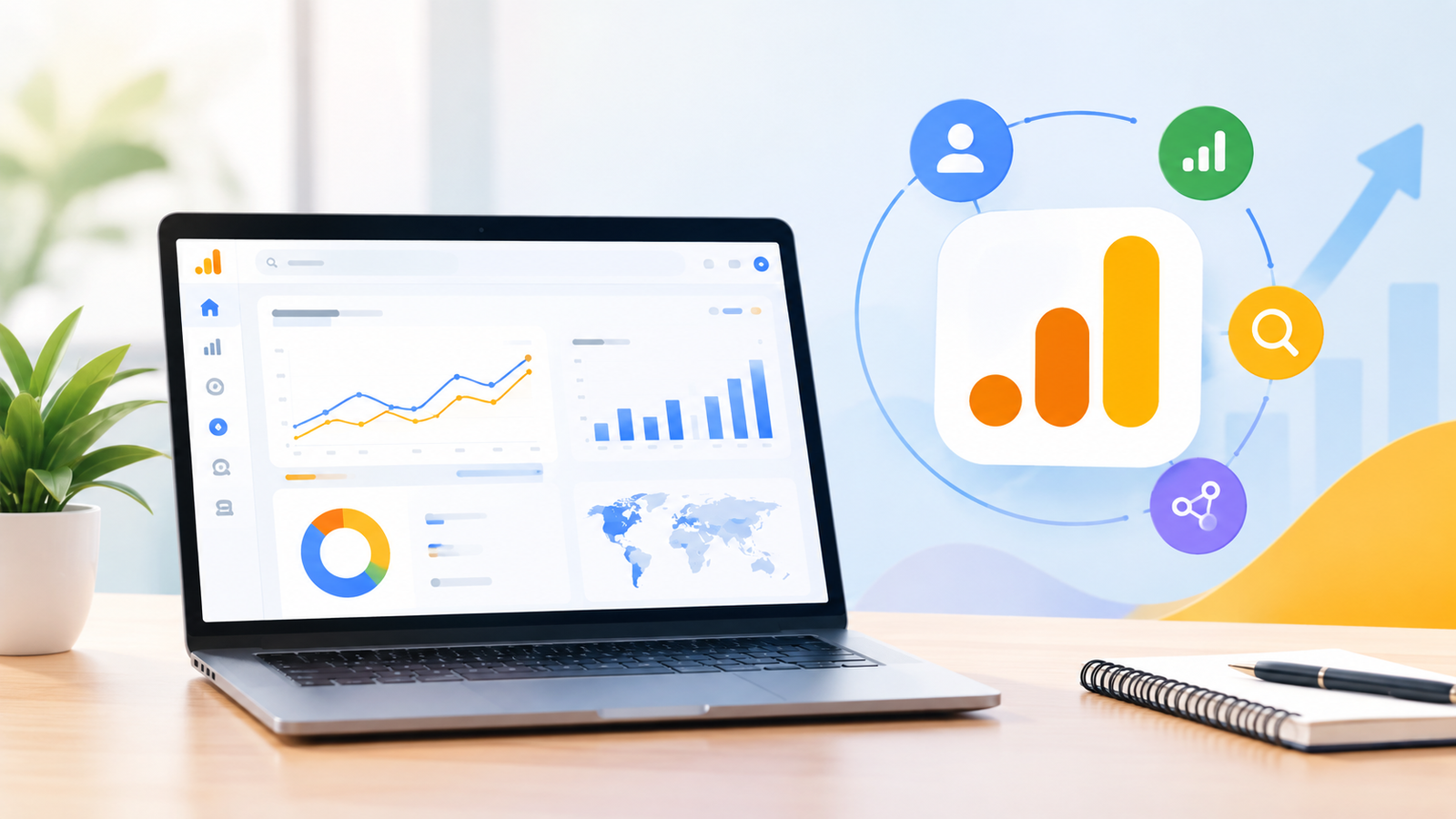
GA4 is Google’s free website analytics platform, and it’s the starting point for every digital marketing decision. It tells you where your visitors come from, what they click, how long they stay, and whether they convert into leads or sales.
Key features:
- Event-based tracking across web and app
- Conversion and goal tracking
- Audience segmentation and reporting
- Integrates directly with Google Ads and Search Console
Why it matters for marketers: You can’t improve what you don’t measure. Every digital marketing course and every real job expects you to read a GA4 dashboard confidently.
Pricing: Free for standard use; GA4 360 (enterprise) is paid.
2. Google Search Console — A Free Digital Marketing Tool for SEO Health
Search Console shows you exactly how Google sees your website — which keywords you rank for, which pages get clicked, and any indexing or mobile usability errors.
Key features:
- Keyword-level performance data (impressions, clicks, CTR, position)
- Index coverage and crawl error reports
- Sitemap submission
- Core Web Vitals monitoring
Why it matters for marketers: It’s the fastest, free way to diagnose why a page isn’t ranking — essential for anyone doing on-page or technical SEO.
Pricing: Completely free.
3. Semrush — One of the Best Digital Marketing Tools for Keyword Research
Semrush is one of the most complete SEO and competitive research platforms available, and it’s a staple in any serious digital marketing tools list. It’s used to find keyword opportunities, audit websites, track rankings, and analyze exactly what’s working for competitors.
Key features:
- Keyword Magic Tool for search volume, intent, and difficulty
- Competitor keyword gap analysis
- Site audit and backlink analysis
- Position tracking over time
Why it matters for marketers: Instead of guessing what to write about, Semrush shows you what people are already searching for and how hard it will be to rank — exactly the process used to research this article.
Pricing: Limited free plan (10 searches/day); paid plans start around $99–140/month. (Ahrefs is a strong alternative in the same price range.)
4. Canva — For Fast, Professional Design
Canva turns anyone into a designer. It’s used across the industry for social media graphics, ad creatives, presentations, and blog banners — no design degree required.
Key features:
- Drag-and-drop editor with thousands of templates
- AI-powered design and image generation tools
- Brand kit for consistent colors, fonts, and logos
- Direct export/scheduling to social platforms
Why it matters for marketers: Visual content drives engagement across every channel. Canva lets you produce it in minutes instead of outsourcing every graphic.
Pricing: Free plan available; Canva Pro starts around $12.99/month.
5. Mailchimp — A Top Digital Marketing Tool for Email Automation
Despite newer competitors, Mailchimp remains one of the most widely used email marketing platforms because it combines ease of use with genuinely powerful automation.
Key features:
- Drag-and-drop email builder and templates
- Audience segmentation and automation workflows
- A/B testing and performance analytics
- Landing pages and basic CRM features
Why it matters for marketers: Email still delivers one of the highest ROIs of any digital channel. Knowing how to build a nurture sequence in Mailchimp is a core, job-ready skill.
Pricing: Free up to 500 contacts; paid plans start around $10–13/month.
6. Google Ads — For Paid Search Advertising
Google Ads puts your business in front of people actively searching for what you offer, through search ads, display ads, YouTube ads, and Shopping campaigns.
Key features:
- Keyword-targeted search campaigns
- Display and YouTube advertising network
- Conversion tracking tied to GA4
- Smart Bidding powered by AI
Why it matters for marketers: PPC is one of the fastest ways to generate measurable leads, and Google Ads certification is one of the most recognized credentials in the industry.
Pricing: No platform fee — you only pay per click or impression, budget-controlled by you.
7. Meta Ads Manager — For Facebook and Instagram Advertising
Meta Ads Manager is the control center for running paid campaigns across Facebook, Instagram, and Messenger — critical for any brand targeting a broad consumer audience.
Key features:
- Detailed audience targeting and lookalike audiences
- Campaign objectives for awareness, leads, and conversions
- Creative testing (A/B testing ad variants)
- Pixel-based retargeting and conversion tracking
Why it matters for marketers: Social ads remain one of the most cost-effective ways to reach a highly specific audience, and most agency and freelance briefs include Meta Ads work.
Pricing: No platform fee — pay-per-click or impression, budget set by you.
8. Buffer — For Social Media Scheduling
Buffer lets you plan and publish content across multiple social platforms from one dashboard, keeping your posting schedule consistent without manual daily work.
Key features:
- Multi-platform scheduling calendar
- AI Assistant for captions and repurposing content
- Basic engagement and performance analytics
- Browser extension for quick content saving
Why it matters for marketers: Consistency is one of the biggest drivers of social growth, and Buffer removes the daily manual effort of posting.
Pricing: Free plan for 3 channels; paid plans start around $5–6/month per channel.
9. HubSpot — An All-in-One Digital Marketing Tool for CRM and Automation
HubSpot combines a CRM, email marketing, landing pages, and automation into one connected system — making it one of the most in-demand platforms in mid-to-large marketing teams.
Key features:
- Free CRM with contact and deal tracking
- Marketing automation workflows
- Landing page and form builder
- Lead scoring and pipeline reporting
Why it matters for marketers: Understanding how leads move from a form fill to a closed sale is core to inbound marketing — and HubSpot experience is frequently listed in job requirements.
Pricing: Free CRM; Marketing Hub paid plans start around $15–20/month.
10. ChatGPT — The Newest Addition to Every Digital Marketing Tools Stack
AI tools like ChatGPT have become part of the everyday marketing workflow — used for brainstorming, drafting copy, summarizing research, and speeding up content production.
Key features:
- Fast copywriting for ads, emails, and blogs
- Content ideation and outline generation
- Research summarization
- Custom GPTs for brand-specific tone and workflows
Why it matters for marketers: AI doesn’t replace strategy, but it removes hours of manual drafting work — making it one of the highest-leverage tools a modern marketer can learn.
Pricing: Free plan available; ChatGPT Plus starts at $20/month.
How to Choose the Right Digital Marketing Tools for You
You don’t need all 10 digital marketing tools on day one. Match them to your current stage:
- Just starting out: GA4, Search Console, Canva, and ChatGPT — all free, and they cover analytics, SEO, design, and content.
- Running paid campaigns: Add Google Ads and Meta Ads Manager.
- Managing a growing audience: Add Mailchimp, Buffer, and HubSpot for email, social, and lead management.
- Scaling SEO content: Add Semrush once you’re producing content regularly and need keyword data.
Frequently Asked Questions
What are the most important digital marketing tools for beginners? Google Analytics 4, Google Search Console, Canva, and ChatGPT are the best starting point. All four are free, cover the core skills of tracking, SEO, design, and content, and are used in almost every entry-level digital marketing job.
Which digital marketing tool should I learn first? Start with Google Analytics 4. Every marketing decision — SEO, ads, email, or social — depends on understanding how visitors behave on your website, which makes GA4 the foundation skill.
Are these digital marketing tools free? Most have a usable free plan — GA4, Search Console, Canva, Mailchimp, Buffer, HubSpot’s CRM, and ChatGPT all offer free tiers. Semrush has a limited free plan, while Google Ads and Meta Ads Manager charge only for the ad spend you set, with no platform fee.
What tools do digital marketing institutes teach? Most digital marketing courses cover Google Analytics, Google Search Console, Google Ads, Meta Ads Manager, an SEO tool like Semrush or Ahrefs, Canva for design, Mailchimp for email, and increasingly, AI tools like ChatGPT for content and research.
Is Semrush or Ahrefs better for beginners? Both cover similar ground — keyword research, competitor analysis, and site audits. Semrush is often preferred for its wider marketing toolkit (including PPC and social features), while Ahrefs is known for stronger backlink data. Either is a solid learning choice.
Final Thoughts on the Top 10 Digital Marketing Tools
Mastering these top 10 digital marketing tools won’t happen overnight, but each one solves a specific, real problem in a digital marketing career — tracking data, ranking on search, designing content, running ads, nurturing leads, and writing faster with AI. Learn them in that order, practice on a real project, and you’ll be ahead of most people applying for the same roles. Bookmark this digital marketing tools list and revisit it as your skills grow.